
Jobs in HR, administration and recruitment have seen a substantial rise as per Monster data with a 42% growth in job posting activity.

Fitch Solutions on Thursday said the new climate targets announced at the COP26 summit by Prime minister Narendra Modi pose an upside risk to its outlook for renewable growth in the country. With the new targets, it expected to see attempts to alleviate the issues regarding supply chains, manufacturing and project development that have long plagued renewable proliferation.

India this year will emerge as the world's seventh largest economy, up from the 12 th position in 2008.

June indicates a change in trend from previous quarters in terms of how much companies are spending on employees. The worst hit sectors included steel, air transport service and automobile firms.
Hindustan Unilever Ltd, India's largest personal care product maker, on Tuesday reported a better-than-expected increase in its September quarter net profit and revenues, signalling a revival of demand following the world's biggest lockdown.

With domestic retail fuel prices jumping to record high on rising international oil rates, India on Thursday pressed oil cartel OPEC for 'affordable' oil price within a 'reasonable band' and that the producers should phase out production cuts. OPEC nations such as Saudi Arabia have traditionally been India's principal oil source. But, OPEC and its allies, called OPEC+, ignoring its call for ease supply curbs had led to the world's third-biggest oil importer tap newer sources to diversify its crude oil imports. As a result, OPEC's share in India's oil imports has dropped to about 60 per cent in May from 74 per cent in the previous month.

Li is currently attending the WEF annual meeting in Davos in back drop of release of the annual GDP figures by China highlighting the continuation of the slowdown of the world's second largest economy.

With corruption rankings, the White-Anglo-Saxon-White Caucasian countries have succeeded in discovering a replacement for the old form of imperialistically deracinating the rest of the world, argues Sudarshan Madabushi.
China is keen to rebalance its economy towards higher consumption, services, technology use and value-added exports. The hope is that its currency will strengthen as the world embraces it as a global trade and reserve currency, say Abheek Barua & Bidisha Ganguly.

China has cast a long shadow on India's economy.

'Wherever in the world there is political instability, those countries are beset with severe crises today. But India is in a much better position than the rest of the world due to the decisions taken by my government in the national interest,' President Droupadi Murmu said in her address to both Houses of Parliament.
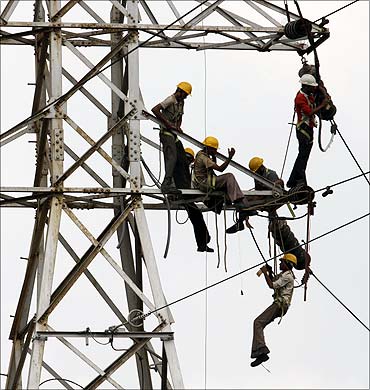
Africa is second only to West Asia as a net exporter of oil.

'They say 'a picture paints a thousand words', so seeing Rishi Sunak PM at the door of Number 10 can never be taken from us.'' 'It is a symbol that will go down in the history books.' 'It is the very embodiment of me saying to my boys, "You can be who you want to be",' notes James Salins in this must-read feature.

While the US-Iran conflict leading to a spike in global oil prices and trade war between the US and the EU topped the chart with 25 per cent, other major risks to the global economy include coronavirus, debt burdens causing a recess across emerging markets and Hong Kong protests causing an exodus from Asia's biggest financial centre.

Poor governance and mediocre short-sighted politics are destroying the paradise that Goa was as its environment, water table, culture and way of life is drastically threatened by tourism and migration, points out Ramesh Menon.

Prime Minister Modi, who is in Japan on a two-day visit to attend a summit of the Quad leaders at the invitation of his Japanese counterpart Fumio Kishida, penned an op-ed on the vibrant relations between India and Japan in the Yomiuri Shimbun.

The global ratings agency keeps India's sovereign rating unchanged at 'BBB-' with stable outlook

India expects to remain unscathed this time, mainly because it is in a sweet spot as the world's third largest oil consumer, after the US and China, says Subhomoy Bhattacharjee.

India's economy, estimated to contract by 6.9 per cent in 2020 due to the coronavirus pandemic, is forecast to record a "stronger recovery" in 2021 and grow by 5 per cent, according to a UN report which said the country's current fiscal year budget points to a shift towards demand-side stimulus, with an uptick in public investment. The report, 'Out of the frying pan ...Into the fire?' published Thursday as an update to the Trade and Development Report 2020 by UN Conference on Trade and Development (UNCTAD) said the global economy is set to grow by 4.7 per cent this year, faster than the 4.3 per cent predicted in September 2020, thanks in part to a stronger recovery in the US, where progress in distributing vaccines and a fresh fiscal stimulus of $1.9 trillion are expected to boost consumer spending.
Alibaba's pervasive economic and social influence in China is seen as a threat to the authority of the Chinese Communist party, notes Shyam Saran.

Investing in the US market provides Indian investors a hedge against the rupee's long-term tendency to depreciate against the dollar.
The 30-share BSE Sensex shed 0.9% or 186 points at 20,536 while the 50-unit NSE Nifty was off 1% or 61 points at 6,091.
Macro-economic data from China and minutes of the US Federal Reserve's last meeting caused the turmoil as stocks tumbled around the globe.
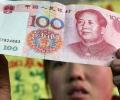
China's economy grew 6.7 percent in the second quarter from a year earlier.
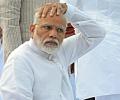
Moody's Investors Service on Friday slashed its estimate of India's GDP growth during the 2020 calendar year to 2.5 per cent from an earlier estimate of 5.3 per cent, on account of the rising economic cost of the coronavirus pandemic.

IPO-bound mobility platform Ola, said it has successfully raised $500 million via a Term Loan B (TLB) from marquee international institutional investors. This term loan has no impact on the valuation of Bhavish Aggarwal-led Ola. The Bengaluru-based firm recently raised $139 million. This is part of a $1 billion funding round for which the company is in talks with investors, increasing its valuation to about $7.5 billion, according to the sources.

With the world's worst outbreak of COVID pandemic stalling a nascent economic recovery, the government has begun assessing the impact of the second wave of infections on different sectors and may look at providing support at an appropriate time to segments requiring fiscal help. Some of the economic indicators, including the Goods and Services Tax (GST) collections, still provide confidence and incoming data will throw some more light on the state of the economy, sources said. Services sectors like hospitality, tourism and aviation which had just started recovering were hit hard by the second wave of COVID, the sources said, adding these segments might need some support on an urgent basis from the government.
According to experts, work from home, volatility in stock markets worldwide, and redemption pressures compelled investors to defer new investment plans.
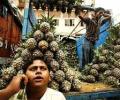
The readings, for the month of October, are based on Composite Leading Indicator that are designed to anticipate turning points in economic activity relative to trend.

In India we have to be careful not to copy any level of dependence on the financial sector and infatuation with the get-rich-quick syndrome, says Jaimini Bhagwati.

If it doesn't do that, what Uddhav Thackeray postpones addressing today will be there on the table to confront, for whoever anchors the Sena in the years ahead, observes Shyam G Menon.

India's gold demand recovered during the January-March period to witness a growth of 37 per cent at 140 tonne compared to the same quarter of 2020, due to ease of COVID-related restrictions, pent up demand and softening of prices of the yellow metal, according to the World Gold Council (WGC). The overall gold demand stood at 102 tonne during the first quarter of 2020, as per WGC data. Gold demand in value terms increased by 57 per cent during the first quarter of this calendar year to Rs 58,800 crore compared to Rs 37,580 crore in the corresponding period of 2020.

According to the 2013 International outlook by Columbia Management and Threadneedle Asset Management, its global partner, pace of growth in emerging markets have witnessed a slowdown over the last year, but still about 70 per cent of the world's incremental growth comes from these markets.

'The big power struggle in faraway Europe erupted at a most critical juncture when India has been increasingly sceptical about American policies and statesmanship,' argues Ambassador M K Bhadrakumar.
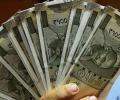
The year-to-date returns are 13.33 per cent for Indian funds, compared to 11.66 per cent for emerging market funds overall.

The hit to economic activity will be mostly confined to the first quarter. And a third wave, if it materialises, is unlikely to be hugely disruptive for the economy, predicts T T Ram Mohan.

It includes a session with Gadkari on analysing the initiatives needed to bridge the $1 trillion infrastructure deficit in the country.

Soon after Prime Minister Modi's assertion, the G20 countries also came down heavily on terrorism.

'It may sound like sacrilege, but does it really matter if the global raters downgrade India for fiscal slippage?' asks Tamal Bandyopadhyay.

The US dollar strengthened against the world currencies after the Turkish lira dived almost 8 per cent, sparking a sell-off in global markets.
